
A properly installed asphalt surface in Pennsylvania typically lasts 15 to 25 years, but local weather and pavement conditions can shorten or extend that range. Freeze-thaw cycles, water infiltration, vehicle weight, installation quality, and maintenance all influence how quickly deterioration develops. Understanding these variables helps property owners plan timely repairs and avoid premature replacement. This guide explains what determines asphalt pavement life expectancy and when repair, resurfacing, or replacement may be appropriate.
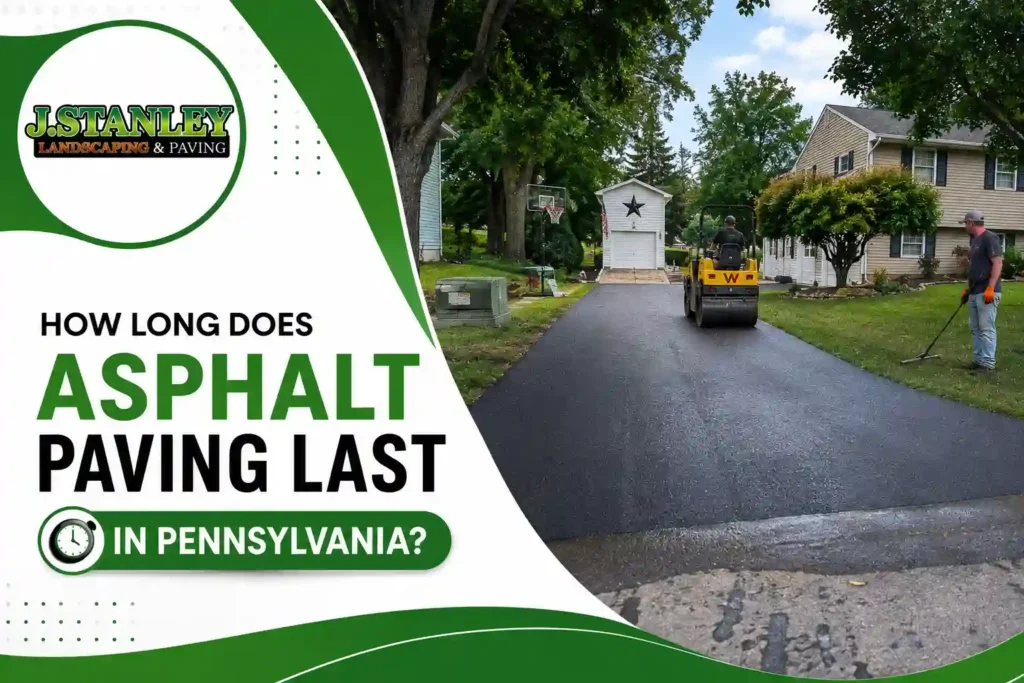
How Long Does Asphalt Paving Typically Last in Pennsylvania?
Asphalt paving in Pennsylvania generally remains serviceable for 15 to 25 years. The expected lifespan differs between residential and commercial surfaces because each pavement type carries different traffic volumes, loads, and operational demands.
How Long Does a Residential Asphalt Driveway Last?
A professionally installed residential asphalt driveway can typically last 15 to 25 years. Because most driveways support passenger vehicles rather than continuous traffic, they experience less structural stress than commercial pavement.
The end of an asphalt driveway’s lifespan does not begin with the first visible crack. Minor surface defects can develop while the pavement remains stable and functional. A driveway approaches the end of its usable life when cracking, settlement, or surface failure becomes extensive enough that repeated repairs no longer provide a reliable solution.
How Long Does Commercial Asphalt Pavement Last?
Commercial asphalt pavement often lasts approximately 10 to 20 years under regular use. Parking lots, access roads, loading zones, and entrance drives usually deteriorate faster than residential driveways because they accommodate frequent traffic, heavy vehicles, tight turning movements, and repeated braking.
Wear may also develop unevenly across a commercial property. Parking spaces may remain relatively stable while entrances, delivery lanes, and loading areas decline sooner. For this reason, commercial pavement life expectancy should be assessed by traffic zone rather than by property age alone.
Why Is Asphalt Lifespan Not a Fixed Number?
An asphalt surface does not automatically fail after reaching a specific age. Its service life is measured by structural condition, surface performance, drainage function, and repair frequency.
Two paved surfaces installed in the same year can age differently because they operate under different conditions. One may remain suitable for routine maintenance, while another may require resurfacing or replacement. The most reliable estimate combines pavement age with visible deterioration and an evaluation of the underlying structure.
How Does Pennsylvania’s Climate Affect Asphalt Pavement?
Pennsylvania asphalt pavement faces repeated temperature changes, precipitation, snow, and summer heat. These conditions alter the asphalt surface throughout the year, allowing minor defects to develop into deeper pavement deterioration.
How Do Freeze-Thaw Cycles Damage Asphalt?
A freeze-thaw cycle begins when water enters pores or existing cracks in the pavement. As temperatures fall below freezing, the trapped water expands and places pressure on the surrounding asphalt and aggregate. When the ice thaws, it can leave small gaps within the pavement structure.
Repeated cycles gradually widen cracks and loosen surface material. If moisture reaches the base layer or subgrade, the pavement may lose support and begin to settle. This movement can contribute to depressions, interconnected cracking, and pothole formation.
How Do Snow, Ice, and Deicing Materials Affect Asphalt?
Snow and ice keep the asphalt surface exposed to moisture for extended periods. Melting snow can enter open cracks during the day and refreeze when temperatures drop, increasing internal stress within the pavement.
Deicing materials can increase the number of freeze-thaw events by lowering the freezing point of surface moisture. Snowplow blades may also scrape loose aggregate or catch raised pavement edges. The risk is greatest where the asphalt is already cracked, brittle, or structurally weakened.
What Do Summer Heat and Sunlight Do to Asphalt?
Heat softens asphalt binder and makes the surface more vulnerable to movement under concentrated loads. Repeated heating and cooling also cause the pavement to expand and contract, placing stress around joints, edges, and existing cracks.
Ultraviolet radiation gradually oxidizes the asphalt binder, reducing its flexibility and changing the surface from deep black to gray. As oxidation progresses, the pavement becomes more brittle and less able to adjust to temperature changes. Pennsylvania’s combination of hot summers and freezing winters can therefore accelerate surface aging across the same pavement system.
What Determines How Long Asphalt Paving Lasts?
The lifespan of asphalt paving depends on how effectively the entire pavement structure supports traffic and manages environmental stress. The surface layer, aggregate base, subgrade, drainage, and intended vehicle use must function as one system.
Subgrade Preparation and Base Stability
The subgrade is the compacted soil beneath the pavement, while the aggregate base distributes vehicle loads before they reach that soil. Weakness at either level allows the asphalt surface to flex, settle, or shift.
Long-term stability depends on:
- Soil compaction: Loose soil can compress after paving and create depressions.
- Base thickness: An undersized aggregate layer may not distribute loads effectively.
- Material consistency: Soft areas or poorly graded aggregate can produce uneven support.
- Subgrade condition: Expansive, saturated, or unstable soil can move beneath the finished pavement.
Surface repairs cannot permanently correct movement caused by a failing foundation. Cracks and depressions often return unless the unstable material below the asphalt is addressed.
Asphalt Thickness and Installation Quality
Asphalt thickness should match the pavement’s expected use. A residential driveway designed for passenger vehicles requires a different pavement structure than a loading area used by delivery trucks.
Installation quality also affects how well the asphalt resists deformation and cracking. Key construction variables include:
- Appropriate asphalt mixture for the application
- Consistent material depth across the paved area
- Placement within the correct temperature range
- Adequate compaction before the mixture cools
- Secure joints and properly finished edges
Insufficient compaction leaves excess air voids that allow water and oxygen to penetrate the surface. Excessive compaction can damage the aggregate structure. Proper density creates a stable pavement layer without reducing its ability to perform under load.
How Does Drainage Affect Asphalt Lifespan?
Effective drainage directs water away from the asphalt surface and prevents prolonged saturation beneath it. The finished pavement must have enough slope to move runoff toward suitable drainage points without creating standing water.
Drainage problems can affect pavement in several ways:
- Ponding water increases moisture exposure at cracks and low areas.
- Runoff entering open pavement edges can erode the aggregate base.
- Saturated subgrade soil loses load-bearing capacity.
- Concentrated water flow can wash out support beneath isolated sections.
A pavement surface may appear intact while water is weakening the structure below it. Depressions, edge settlement, and recurring cracks can indicate that moisture has already affected the base or subgrade.
How Do Traffic Volume and Vehicle Weight Affect Asphalt?
Vehicle loads create downward pressure and bending stress within the pavement structure. The number of load cycles matters, but axle weight has an even greater effect on structural demand. A surface exposed to heavy trucks can deteriorate faster than one carrying a larger number of passenger vehicles.
Specific traffic patterns also concentrate wear:
- Tight turns push and distort the asphalt surface.
- Repeated braking places horizontal stress on the pavement.
- Stationary trailers create sustained pressure at contact points.
- Vehicles traveling along the same path repeatedly form wheel-track depressions.
- Unsupported edges may crack when vehicles drive or park too close to them.
Pavement thickness and base design should therefore reflect actual traffic conditions, not only the size of the paved area.
How Can You Extend the Life of Asphalt Pavement?
Preventive maintenance extends pavement life by limiting moisture intrusion, surface oxidation, and progressive damage. The most effective strategy is to correct small defects while the asphalt and its supporting layers remain structurally stable.
Seal Cracks Before Water Reaches the Base
Crack sealing fills non-structural openings with a flexible material that moves with the pavement. It restricts water and debris from entering the crack and reduces the risk of further separation.
Cracks should be evaluated when they first appear, especially before winter. They must also be classified correctly. Crack sealer may protect an isolated surface opening, but it will not stabilize alligator cracking or movement caused by base failure. Treating structural damage as a surface defect often leads to recurring cracks.
Apply Sealcoating at the Right Time
Professional sealcoating adds a protective layer over sound asphalt and slows exposure to sunlight, moisture, fuel, and surface wear. It can also restore a uniform appearance, but it does not repair potholes, unstable pavement, or deep structural cracks.
Many asphalt surfaces are evaluated for sealcoating every two to three years, although the appropriate schedule depends on surface condition, traffic, previous applications, and product specifications. Applying thick or excessive coats can create peeling, tracking, or curing problems. New asphalt must cure adequately before receiving its first application.
Keep the Surface and Drainage Paths Clear
Routine inspections can identify conditions that trap water or obstruct runoff. Property owners should check the pavement after heavy rain and before winter to locate ponding, blocked inlets, and debris buildup.
Useful upkeep includes:
- Removing leaves, sediment, and debris from drains and pavement edges
- Cleaning oil or fuel spills before they soften the asphalt binder
- Keeping vegetation from growing through cracks or along unsupported edges
- Confirming that downspouts do not discharge directly onto paved areas
- Correcting low spots that continue to hold water
These actions preserve the pavement’s intended drainage pattern and reduce unnecessary surface exposure.
Repair Small Areas Before Damage Spreads
Localized repairs are most effective while deterioration remains confined to a specific area. A small pothole, broken edge, or isolated depression can expand as vehicles loosen surrounding material and water enters the damaged section.
Early corrective work may involve crack treatment, pothole patching, edge restoration, or removal and replacement of a failed section. The repair method should address the depth of the defect. Surface patching may be suitable for shallow damage, while failure extending into the base requires excavation and reconstruction of the affected area.
Frequently Asked Questions
How long does an asphalt driveway last in Pennsylvania?
A properly installed and maintained asphalt driveway in Pennsylvania commonly lasts about 15 to 25 years. Its actual lifespan depends on the pavement structure, exposure to moisture, traffic loads, and how quickly small cracks or surface defects are addressed.
Does cold weather damage asphalt?
Cold weather can accelerate asphalt damage when water enters cracks and freezes. Expanding ice places pressure on the pavement, and repeated freeze-thaw cycles can widen cracks, weaken support beneath the surface, and contribute to potholes or settlement.
How often should asphalt be sealcoated?
Many asphalt surfaces are assessed for sealcoating every two to three years. The appropriate schedule depends on traffic, surface wear, previous coating condition, and the manufacturer’s application guidance. Sealcoating should only be applied after the asphalt has cured and necessary repairs are complete. You can learn more about professional sealcoating services for protecting an asphalt surface.
Can proper drainage extend the life of asphalt?
Proper drainage can significantly protect asphalt pavement by moving water away from the surface, base, and subgrade. A paved area that drains effectively is less likely to develop standing water, edge deterioration, settlement, and recurring moisture-related surface damage.
What makes asphalt wear out faster?
Asphalt can deteriorate faster when it has poor base support, inadequate thickness, frequent heavy-vehicle traffic, standing water, untreated cracks, or delayed repairs. These conditions place added stress on the pavement and allow damage to progress below the visible surface.
When should old asphalt be replaced?
Old asphalt may need replacement when it shows widespread alligator cracking, repeated potholes, major settlement, soft areas, or persistent drainage issues. These signs often indicate structural failure beneath the surface, where patching or resurfacing may not provide a lasting result.
Serving Pennsylvania and Nearby Areas
J. Stanley Landscaping and Paving provides professional paving services for homeowners and property owners throughout the region. In addition to Northampton, we serve nearby communities, including Bethlehem, PA, Easton, PA, Allentown, PA, Whitehall, PA, Palmer Township, PA, Stroudsburg, PA, Phillipsburg, NJ, Washington, NJ, Blairstown, NJ, Hackettstown, NJ, and Belvidere, NJ.
Need Help Evaluating Your Asphalt Pavement?
If you are seeing cracks, potholes, standing water, or uneven pavement, a professional assessment can identify whether repair, resurfacing, or replacement is the right solution.
Explore our complete range of paving services and paving design options. You can also learn more about J. Stanley Landscaping and Paving or contact our team to schedule an asphalt evaluation.
For more answers about paving and maintenance, visit our Frequently Asked Questions.